
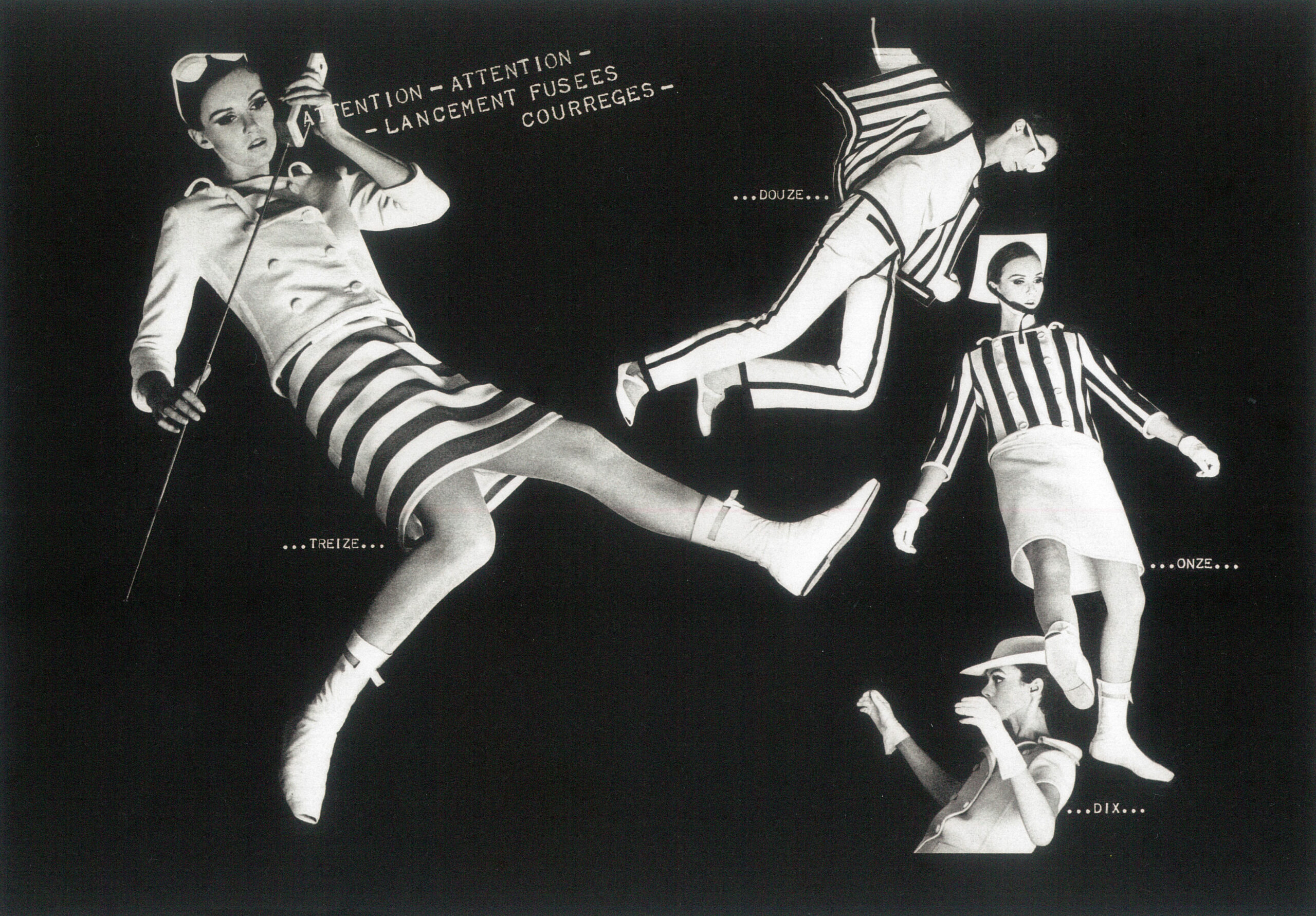
Peter Knapp, Collection Courrèges haute couture printemps-été 1965. Elle n°1002, mars 1965 © Peter Knapp / Courrèges
Ticketing online or on site
For group visits, please contact the reservation service accueil@fondation-maeght.com
Backpacks are not allowed in the Foundation’s exhibition galleries. A cloakroom is available for your personal belongings.
In partnership with 
With the support of 
PETER KNAPP: THE ERA OF COURRÈGES
May 14th – November 8th, 2026
Anny Courtade Gallery (folder exhibition in one gallery)
This project is labeled as part of the “Bicentennial of Photography” by the French Ministry of Culture and is included in the official program running from September 1, 2026 to September 30, 2027.
From May to November, 2026, the Fondation Maeght presents its first thematic exhibition blending art and fashion, featuring a special exhibition curated by photographer Peter Knapp. A close friend of André Courrèges and the Maeght family, he lived through those years of modernity, capturing them in his studio, on the street, and even at the Fondation Maeght.
In 1965, André Courrèges presented his spring-summer haute couture collection. He developed a new vision of fashion, deliberately setting aside conventions to focus solely on the silhouette and architecture: miniskirts, white, structured forms… In this collection, he shaped the female silhouette according to rules that belong as much to architecture as to fashion. The modern woman was born; it was the explosion of the Courrèges style, “a style that is not merely an aesthetic vision but corresponds to a profound philosophy defining a way of life.”
Dubbed the “bombe Courrèges” (Courrèges bombshell) by the press, this collection was a revolution in the fashion universe. Peter Knapp was there to photograph it—with complete creative freedom! In the March 1965 issue of ELLE (No. 1002), the photographer presents this new Courrèges woman through an elliptical series, making his models appear to float, suspended in space. This series forms the heart of the exhibition, featuring four large prints completed by other series, archival materials, and outfits photographed by Knapp in 1965, generously loaned by the House of Courrèges.
Friendship is central to the Fondation Marguerite et Aimé Maeght. Indeed, when they established it, the couple envisioned it as a place where artists from all disciplines could come together. The first foundation in France dedicated to modern and contemporary art, inspired by major American foundations—Barnes, Guggenheim, Phillips—it was immediately recognized as a public benefit organization. This visionary project marked a true turning point for the art world: a private patron of culture and a modern building for modern art!
“As a child, I was struck by a photograph published in the American magazine Vogue: it showed Alberto
Giacometti posing with his Femme debout sculptures.”
Peter Knapp, foreword to the book Giacometti, La ressemblance impossible. Peter Knapp and Giorgio Soavi, Éditions André Sauret / Michel Trinckvel, 1991.